Wrought Iron Restoration & Repair in Chesterfield & Mansfield: Bringing Old Gates Back to Life
We restore wrought iron gates, railings & fencing across Nottinghamshire, Derbyshire & Birmingham. Honest advice on cleaning, welding & repainting old ironwork.
Old ironwork is worth saving. Here is how we do it.
Rusty gates, pitted railings, a section of fencing that has been sagging for two winters. Most people assume the answer is a full replacement. Often, it is not. Wrought iron is remarkably tough, and with the right preparation and welding it can last another generation. We have restored pieces that looked beyond saving and watched them go back onto posts looking better than they did when they were new.
At Jayded Metalworks, based at Unit 4 Draycott Mills, Market Street, Draycott, DE72 3NB, we travel across Nottinghamshire, Derbyshire, Birmingham and the wider West Midlands to measure up, assess damage and carry out wrought iron restoration properly. This article explains exactly what that process involves, when repair makes sense and when it does not.
Will wrought iron rust, and how bad can it get?
Yes, it will rust. All ferrous metals do when moisture reaches bare metal. The difference with wrought iron is that it rusts relatively slowly compared with mild steel, and the rust tends to be surface-level for a long time before it becomes structural. A gate that looks terrible from the street may have only surface oxidisation, flaking paint and some localised pitting, all of which we can address.
The point where rust becomes a structural problem is when it has eaten through a section entirely, or when joints have corroded to the point where they no longer hold. Hollow sections rust from the inside too, which is harder to spot. When we visit a site in Mansfield, Chesterfield or Beeston, we probe the metalwork physically rather than just eyeballing it. A screwdriver tap tells you a lot about what is underneath.
Cleaning wrought iron: what actually works
Before any welding or painting can happen, the metal has to be clean. Properly clean. Paint applied over rust is wasted effort.
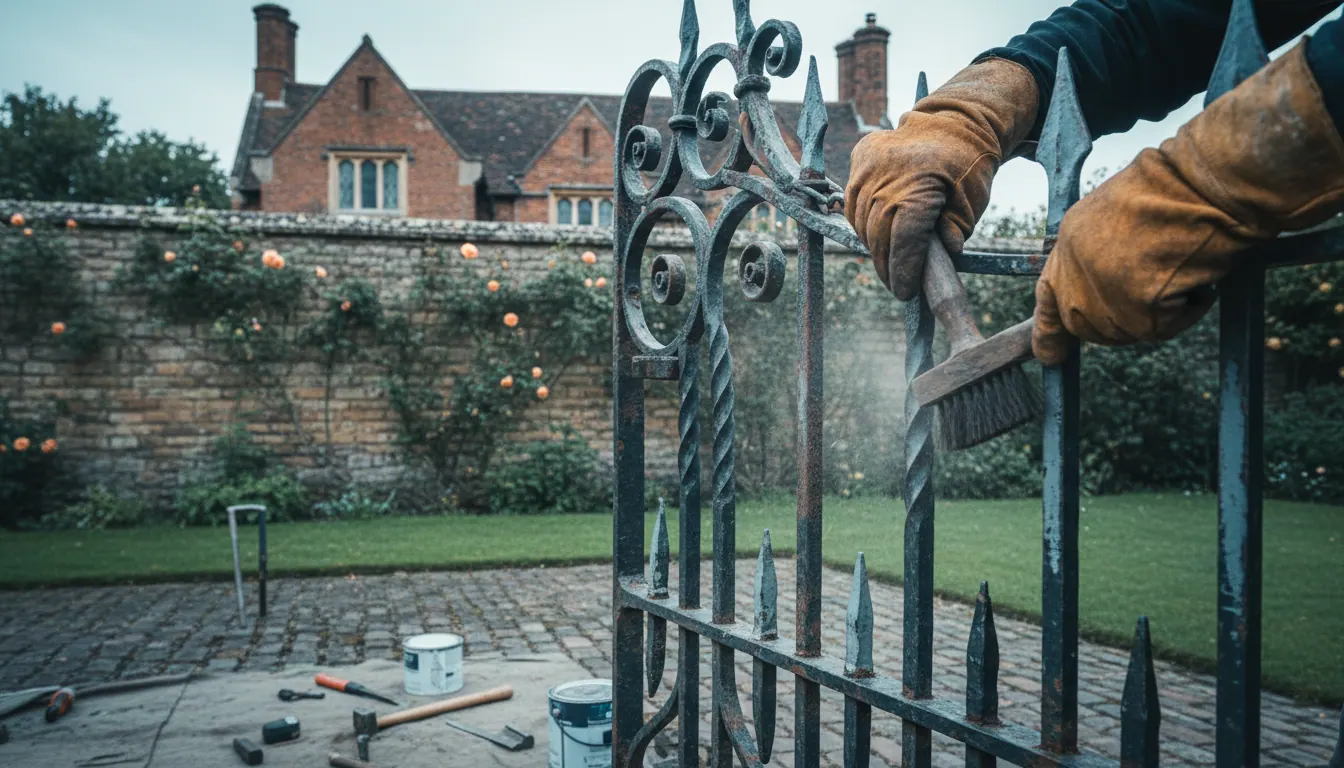
For most domestic ironwork across Nottingham, Derby and Ilkeston, we use a combination of:
- Wire brushing and grinding to remove loose rust and flaking paint
- Angle grinder with a flap disc for heavier corrosion on flat sections
- Needle scaler for intricate scrollwork or decorative detail where a grinder would damage the profile
- Rust converter on pitted areas where mechanical removal alone would not get back to clean metal
If you are doing a small patch yourself before calling us, a wire brush and a proprietary rust converter from a builders' merchant will hold things temporarily. But for a full restoration, you need to get back to bare metal before primer goes on, otherwise the rust continues underneath and the paint lifts within a year.
We do not use acid dipping on site, but for severely corroded pieces that can be removed and transported, we can discuss whether a specialist dip-and-prime service makes sense before we do the finish welding and fitting. We will always tell you honestly which approach suits the job.
What do you weld wrought iron with?
This is a question we hear often, and it matters. True wrought iron (the kind found in Victorian and Edwardian gates and railings in Nottinghamshire and Derbyshire) has a very low carbon content and is fibrous in structure. It behaves differently from modern mild steel under heat.
For repair welding on wrought iron, we use MIG or TIG depending on the section size and the nature of the repair:
- TIG welding gives us the most control and produces the cleanest weld with minimal heat distortion. It is our preference for decorative ironwork where the weld needs to be dressed back and made invisible.
- MIG welding is faster and suits structural repairs on thicker sections, such as gate frames and post collars, where speed matters more than cosmetic finish.
The key with wrought iron is heat management. Too much heat in one area causes warping and can crack the slag inclusions that are natural to the material. We work in short runs, allow cooling time and check alignment throughout. Rushing it creates problems that are harder to fix than the original damage.
If a section has corroded beyond welding, we fabricate a matching replacement piece and integrate it into the existing gate or railing. The goal is always for the repair to be invisible once painted.
Putty, fillers and surface repairs: what is worth using
A question that comes up regularly is whether body filler or metal putty can fix pitting or small holes in ironwork. The honest answer is: sometimes, for cosmetic purposes, but not for anything structural.
For shallow surface pitting on flat sections, a two-part metal repair epoxy (the kind sold for car bodywork repairs) can fill and smooth before priming. It will not corrode, it sands well and it takes paint. For anything deeper than a few millimetres, or for holes, the only proper fix is welding. Putty over a structural void will crack with movement and let moisture in behind it.
We are always straight with customers about this. If a gate hinge collar has rusted through, no amount of filler will make it safe. That needs welding or a replacement collar fabricated and fitted.
Repainting: primer, topcoat and finish
Once the metal is clean and any welding is done, the coating system matters as much as anything else.
For wrought iron restoration across our service area, we use:
- Red oxide or zinc phosphate primer, applied straight to bare metal. This is the most important coat. It inhibits rust and gives the topcoat something to bond to.
- Two coats of a quality metal paint, either hammered finish or smooth depending on the customer's preference and the style of the ironwork.
- Black is traditional for Victorian and Edwardian ironwork, but we finish in whatever the customer wants.
We brush-apply rather than spray for on-site work, which gives better penetration into scrolls and joints. For pieces brought into the workshop, we can spray for a more uniform finish.
One thing worth knowing: a cheap topcoat over good primer will last longer than an expensive topcoat over poor preparation. The prep is everything.
When restoration is not worth it
We will always tell you if replacement makes more sense. If the ironwork is so far gone that the cost of restoration approaches or exceeds a new fabricated piece, we will say so. We can make new gates, railings and sections in mild steel that match the style of the original, powder-coated or painted to suit. Mild steel is not wrought iron historically, but for most residential applications in Nottingham, Derby, Long Eaton and Birmingham it is perfectly appropriate and will last decades with the right finish.
If you have a listed building or a conservation area property in Derbyshire or Nottinghamshire, there may be obligations to restore rather than replace. That is worth checking with your local planning authority before we discuss options. We work with whatever constraints apply.
For more on what goes into making gates and railings from scratch, our article on sheet metal fabrication for gates and railings covers the in-house process in detail.
Repairs across Nottinghamshire, Derbyshire and the West Midlands
We travel to sites across the whole of our service area. That includes Nottingham, Derby, Long Eaton, Beeston, Ilkeston, Mansfield and Chesterfield as well as Birmingham and the wider West Midlands. If you have ironwork in Wolverhampton, across the Black Country or anywhere else in the region, get in touch and we will tell you whether a site visit is practical.
We come to you to measure up and assess before we quote. We do not price jobs blind. If the repair can be done on site, we bring the equipment. If the piece needs to come into the workshop at Draycott Mills, we can often arrange collection.
If your gates or railings need more than restoration, perhaps a new section added or the whole run replaced, take a look at our bespoke metal gates article for Derby and Nottinghamshire for an idea of what we can design and build from scratch.
Frequently asked questions about wrought iron restoration
Will wrought iron always rust eventually? Yes. All iron and steel will rust when moisture reaches bare metal. The key is the coating system. Properly primed and painted wrought iron, maintained every few years with a touch-up coat where the paint chips, will resist rust almost indefinitely. The ironwork that fails is ironwork that has been left with bare patches for years.
What is the best way to clean old wrought iron before repainting? Wire brushing to remove loose material, followed by a rust converter on any pitted areas, then a thorough wipe-down before primer. For anything beyond light surface rust, mechanical grinding back to bare metal gives the best result. Do not paint over rust, even with a rust-inhibiting topcoat. The rust continues to work underneath.
Can wrought iron be welded, and will the repair show? Yes, it can be welded. We use TIG welding for fine decorative work and MIG for heavier structural sections. A well-dressed TIG weld on a flat section, ground back and primed, is effectively invisible once painted. On scrollwork or cast detail, we take more time to blend the repair into the surrounding profile.
Do you restore ironwork across Birmingham and the West Midlands, not just Nottinghamshire? We do. We travel to Birmingham, Wolverhampton and across the West Midlands for restoration work as well as new fabrication. The process is the same wherever the job is: we visit, assess, quote and then carry out the work either on site or in our workshop at Draycott, depending on what the piece needs.
Get in touch
If you have ironwork that needs attention, anywhere across Nottinghamshire, Derbyshire, Birmingham or the West Midlands, we are happy to take a look and give you an honest view of what is worth doing. We quote each job individually once we have seen it. Call us on 07309 647461 and we will arrange a visit.