Welding & Fitting On-Site: When Your Metal Project Needs More Than Workshop Fabrication
We fabricate and weld on-site across Nottinghamshire, Derbyshire and Birmingham. Bespoke gates, railings, handrails and one-off metalwork, made and fitted by hand.
What "on-site welding and metal fabrication" actually means in practice
Some jobs can be fully made in the workshop, loaded onto the van and bolted in. Others need a welder on the ground, at your property, fitting and finishing in place. We do both, and we know the difference.
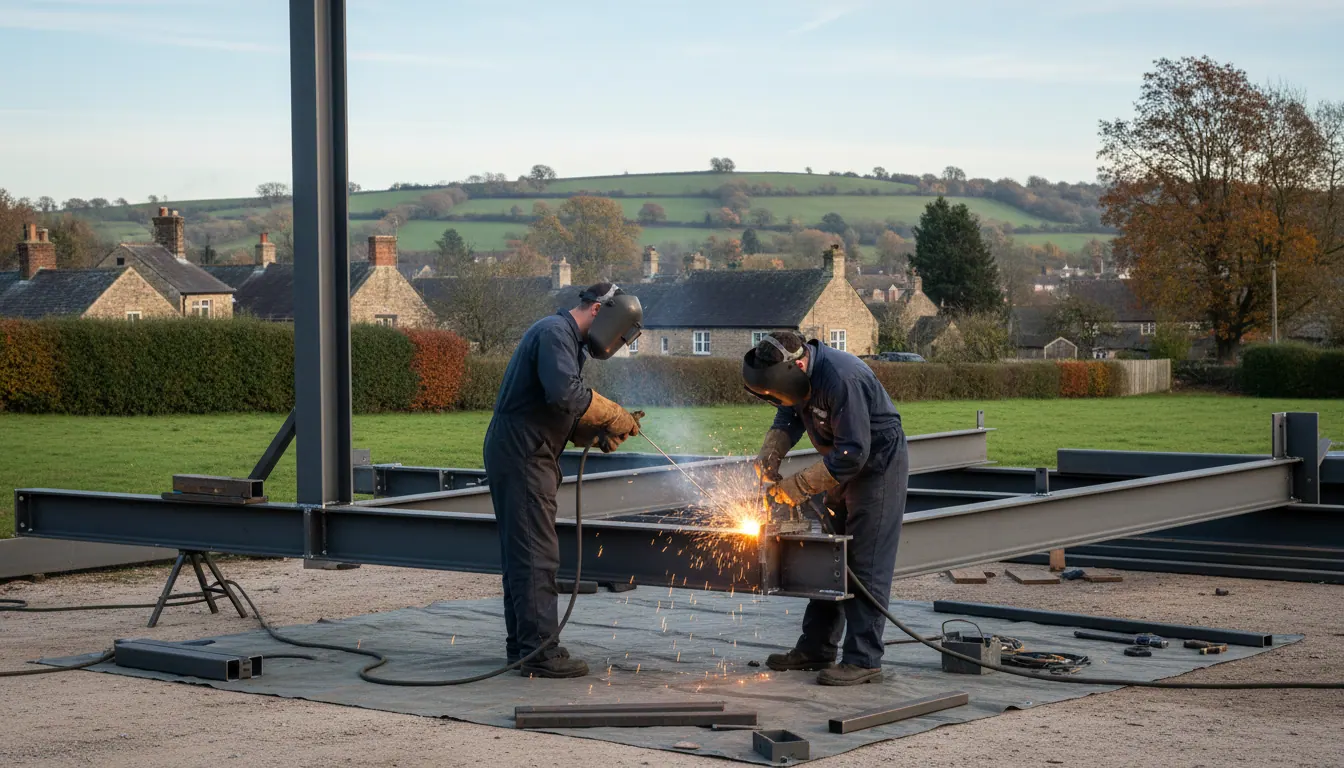
On-site welding and metal fabrication means we come to you. We measure, cut, fit and weld at your home, your site or your commercial premises across Nottinghamshire, Derbyshire and Birmingham. That matters when the job involves awkward geometry, an existing structure that needs tying into, or a repair where removing the piece entirely would cause more damage than it fixes.
We work from our workshop at Unit 4 Draycott Mills, Market Street, Draycott, DE72 3NB, and we travel across the region to measure up, discuss what you need face to face, and then return to fit. It is not unusual for us to weld the main sections in the workshop and complete the final connections on-site. Most bespoke jobs work that way.
Is welding part of metal fabrication, or are they different things?
This is a question we get in various forms. The short answer: welding is one process within fabrication, not a separate trade.
Metal fabrication covers the full journey from raw material to finished piece. That includes marking out, cutting (by hand, angle grinder, plasma or saw), bending, drilling, grinding, fitting and joining. Welding is the joining part, and it is often the most critical stage because a poor weld is a structural weakness.
We use MIG and TIG welding in-house. MIG is faster and well suited to mild steel structural work, things like gate frames, railing posts and brackets. TIG gives a finer, cleaner bead and is the right choice for stainless steel handrails, aluminium sections and anywhere the weld itself will be visible and needs to look as good as it performs. If you want to understand the trade-offs between those two processes in more detail, our article on MIG vs TIG welding: which process for your custom metalwork? covers that properly.
When on-site welding is the right call
Not every fabrication job needs the welder on your driveway. But these situations usually do.
Repairs to existing metalwork. If a gate post has cracked at the base, a railing has been knocked and the upright has sheared, or a set of old wrought iron gates needs a section rebuilt, taking the whole thing down and transporting it is not always practical. We come to the job, assess what is salvageable and weld in situ where it makes sense. For older ironwork in Chesterfield, Mansfield and the surrounding areas, we also restore rather than replace wherever we can. Our article on wrought iron restoration and repair in Chesterfield and Mansfield goes into that process in more detail.
Staircase and landing balustrades. Fitting a balustrade to an existing staircase means working around plaster, timber, flooring and sometimes awkward angles. The posts need to be set and welded level, the handrail run needs to flow correctly, and the final weld connections are nearly always done on-site. There is no way to fully pre-build that in the workshop without risking a fit-up that is millimetres out by the time it reaches the house.
Gate posts set into existing structures. When a driveway already has brick piers, stone pillars or concrete footings, the posts need to be fitted and welded to suit what is actually there, not what the drawings assumed. We measure on-site before we fabricate anything.
Commercial and builder installs. Developers and builders across Nottingham, Derby, Long Eaton and Birmingham often need the metal element of a project completed as part of a wider build programme. That means working around other trades, hitting a specific date and finishing to a standard that does not slow down the next stage. We are used to that.
What we fabricate: the full range
We work in mild steel, stainless steel and aluminium. The list of things we make and fit is broad.
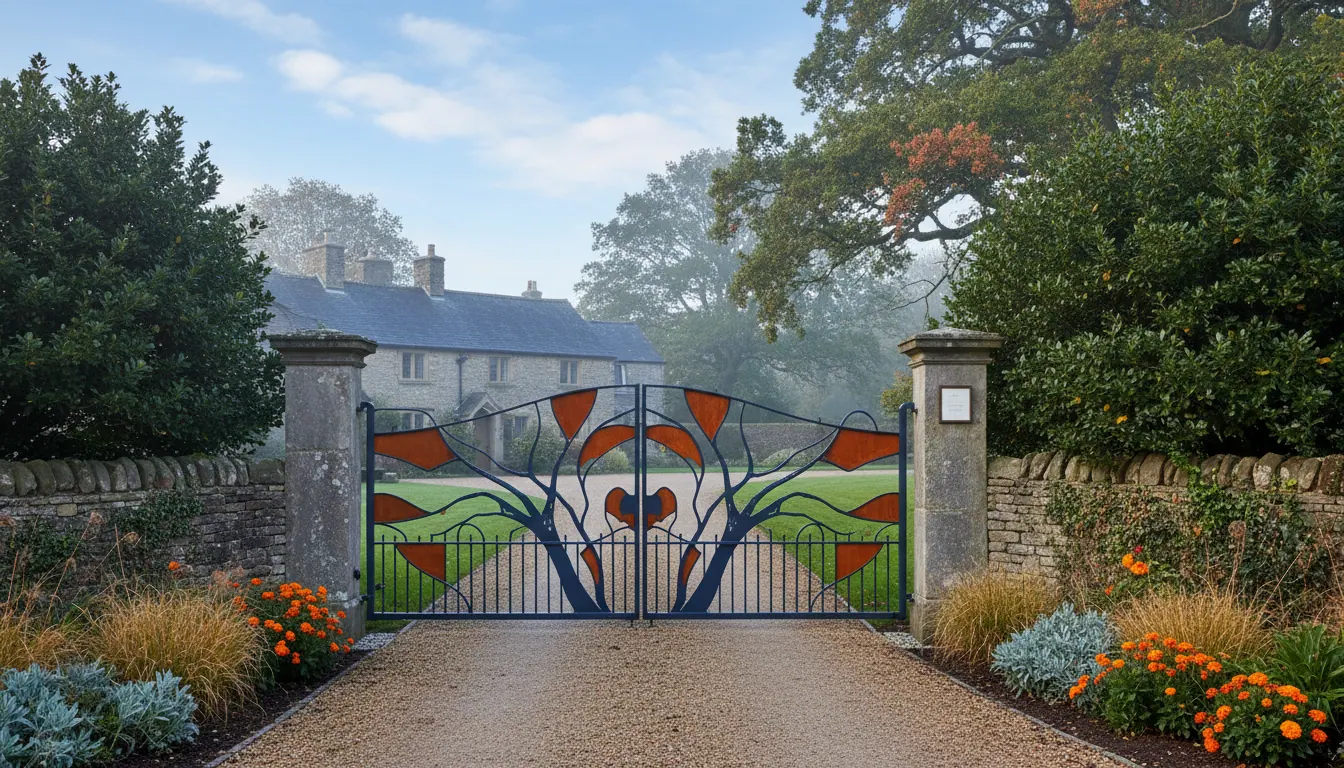
- Bespoke driveway gates, single and double, including electric sliding gates on a track up to 5 metres
- Pedestrian gates and side gates
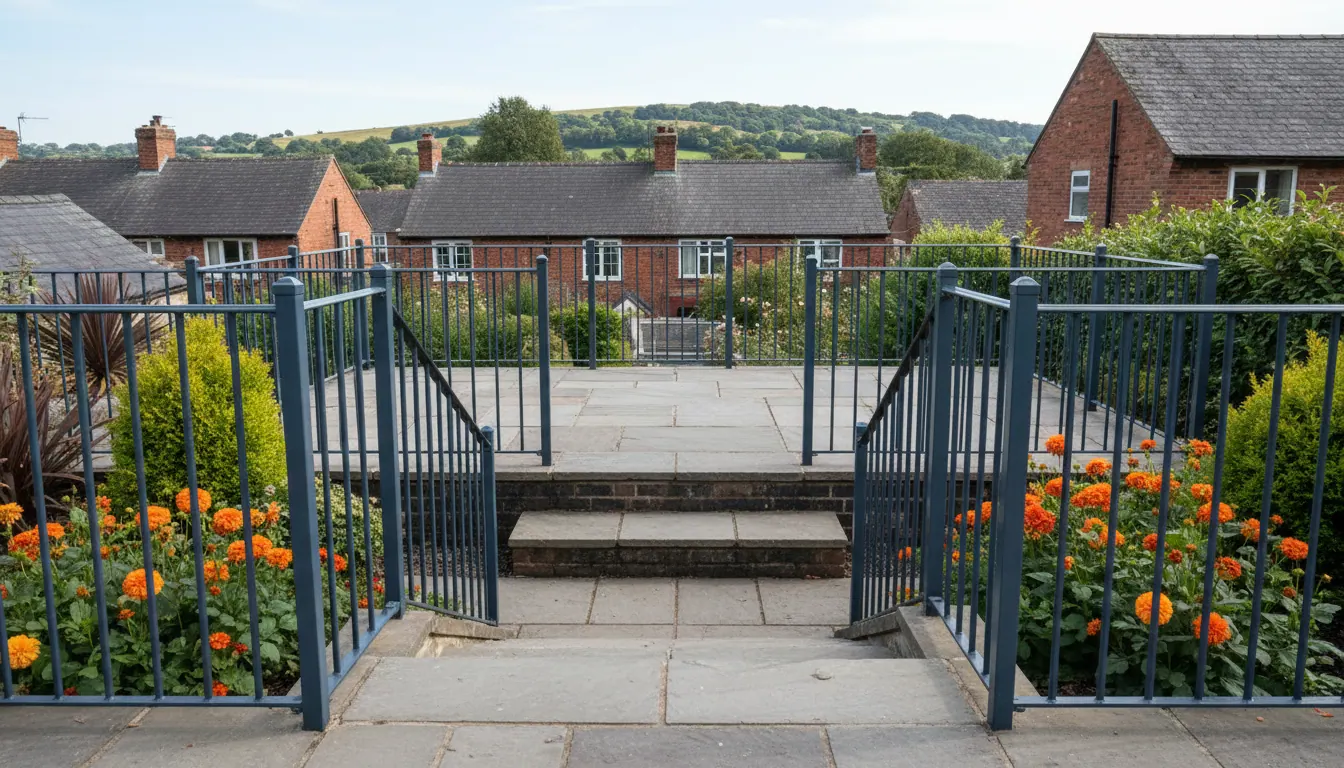
- Garden railings, boundary railings and estate fencing
- Staircase balustrades and landing railings for homes and commercial buildings
- Handrails, both internal and external
- Juliette balconies
- Custom steel furniture: benches, planters, shelving, frames
- Brackets, machine guards, frames and one-off structural components for builders and businesses
- Repairs and restoration to existing gates, railings and ironwork
Everything is designed from scratch. If you have a sketch on paper, a photo from a magazine or a rough idea in your head, we work from that. We do not sell off-the-shelf products. If you want to understand how that design process works, our article on bespoke metal gates from your sketch: how we design and build in Derbyshire and Nottinghamshire explains it step by step.
Working across Nottinghamshire, Derbyshire and the West Midlands
We cover a wide patch. Homeowners in Nottingham, Beeston, Long Eaton, Ilkeston, Derby, Mansfield and Chesterfield make up a large part of our work. We also travel to Birmingham and across the West Midlands for the right job.
That range matters because bespoke fabrication is not a commodity. You cannot easily buy what we make from a catalogue, and the local knowledge, the ability to visit your property before quoting, the on-site fitting, makes a genuine difference to the finished result. A fabricator who works from a photograph and ships to your door cannot do what we do.
We also work with builders and developers on new-build and renovation projects across the region. If you are a contractor who needs a reliable fabricator for the metal elements of a residential or commercial scheme in Nottinghamshire or Derbyshire, we are worth a conversation.
Welding positions and what they mean for on-site work
You may have come across references to welding positions: 1G, 2G, 3G, 4G and 6G. These describe the orientation of the weld relative to the joint.
1G is a flat weld, the easiest. 2G is horizontal. 3G is vertical. 4G is overhead. 6G is a fixed pipe at a 45-degree angle, the most demanding position and often used as a benchmark in welder qualification tests.
In practical on-site fabrication, you rarely get to choose your position. A gate post set into a concrete footing needs welding at ground level, sometimes in a cramped space. A handrail bracket fixed to a wall might need a vertical or overhead pass. A skilled fabricator works confidently in all positions. That is part of what 20 years of hands-on experience gives you.
Frequently asked questions
Is welding the same as metal fabrication?
Welding is one process within metal fabrication, not a separate discipline. Fabrication covers the whole sequence: design, marking out, cutting, bending, drilling, fitting and joining. Welding is the joining stage, and it is often the most structurally important part. When someone asks for a fabricator, they usually need the full process, not just the welding alone.
Does welding come under construction?
It depends on the job. Welding that forms part of a structural element of a building, a balustrade, a load-bearing bracket, a steel gate post set into foundations, sits within the scope of construction work and may be subject to building regulations. We always advise clients to check with their building control officer where there is any doubt, particularly for balustrades and stairs where barrier height and loading requirements apply. We give general guidance on that, but confirming the specific requirement with building control is always the right move.
Can you do on-site welding for small jobs, not just big installations?
Yes. A broken railing, a snapped hinge, a gate that has dropped and needs its frame straightened, these are exactly the kind of jobs we take on. We do not have a minimum job size. If it is worth fixing properly rather than patching with the wrong material, we would rather do it right. Get in touch, describe what you have, and we will tell you honestly whether it is worth a visit.
Can you work from a photo or sketch rather than a technical drawing?
Absolutely, and most of our residential customers come to us that way. A photo of something you like, a rough sketch of what you have in mind, a description of the space and the material, that is enough to start a conversation. We visit the site, take our own measurements and translate what you want into something we can build. You do not need to arrive with a set of engineering drawings.
Get in touch
If you have a project in mind, whether it is a set of gates for a Derby driveway, a staircase balustrade in Nottingham, a repair job in Mansfield or a commercial fabrication contract in Birmingham, we are happy to talk it through. We visit sites across Nottinghamshire, Derbyshire and the West Midlands, Monday to Saturday.
Call us on 07309 647461 and we will arrange a time to come and see what you need.